Patient Engagement, AI, Patient Voice
The patients AI never read about

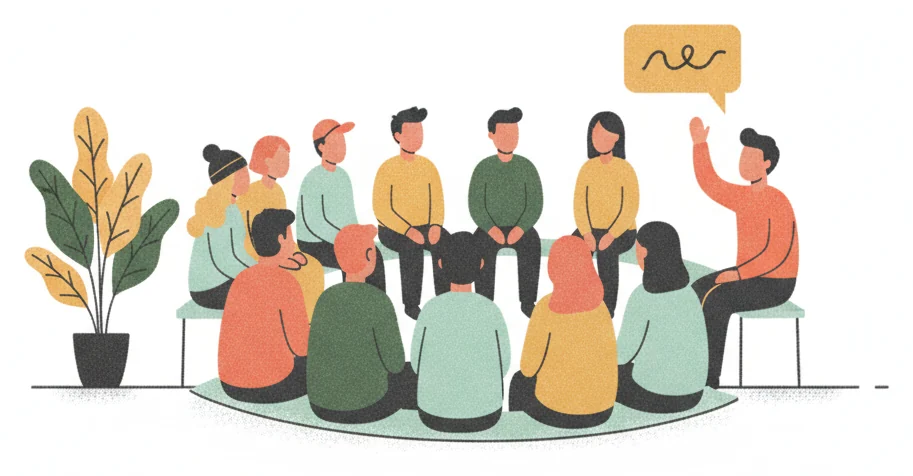
During a qualitative advisory panel project for a clinical trial protocol design, one participant asked how appointments and blood tests (including fasting) would be scheduled for people who don't work in normal hours, e.g. shift work.
It set off a chain reaction. The point was not really shift work. It was that a trial can run over many months, and a person's availability changes across that time for all sorts of reasons, not just their working pattern. The scheduling and testing system needed flexibility built into it. Due to the nature of the blood tests the trial required, the client took that insight on board and it became a clear take-home point for the client team.
Nobody in that session asked whether one voice was enough. The other patients were nodding. The client highlighted it immediately as a good insight. It carried weight because a real person said it out loud, in a room, and everyone watched it land with others, instigating conversation about flexibility and why it is important.
Now picture the same sentence arriving inside a summary of forum posts. Would it have carried the same weight? And if someone had wanted to push on it, to ask what flexible actually means to you, or what would have worked instead, who were they going to ask?
The fundamental limitation of AI synthesis isn't just accuracy; it's reachability. When a real patient's insight is ambiguous, turns out to be wrong, half right, or something we misheard, there is always a route to understanding. We can go back to that person and ask what they meant. We can re-probe to understand the insight better and fix it.
If the insight came out of an AI synthesis and it is wrong, what do you do? Who sorts it out? How do you fix a problem like an AI persona that hasn't actually lived the experience? You can run the prompt again from a different angle, or on different source data, and hope. There is no why to ask, because the data behind the insight, never experienced anything.
Feature: respondents are attributable, named, and can be recontacted.
Advantage: you can carry on probing from where you left off, instead of re-recruiting, re-educating, briefing and bringing new respondents up to speed.
Benefit: deeper insights and possible solutions are found quicker, with less duplication of effort or repeating the whole project with a new group of people.
Some of what we do lets a client stay subscribed to a real patient expert across the life of a project. That means you are not continually scraping the surface with the same primary questions. You get into the nitty-gritty.
What happens when it goes wrong?
There is a second version of this, and it is about defensibility rather than depth.
Feature: a named, declared source.
Advantage: when something is challenged or goes wrong, the team has a map. It provides a pathway to go back, to get clarification and to put a wrong right.
Benefit: the person who signed it off is able to deal with it.
That matters more than it sounds. Somebody's name is on the recommendation that went upstream. If it turns out wrong six months later and their own leadership asks how they knew, "the model said so" is not an answer. Being able to go back to a patient to fully gauge an inconsistency is transparency at its best, and it's human. A synthesis does not offer you that. It offers you a re-run.
Why spend our energy refining prompts to simulate human insight when the authentic version is right in front of us? AI is an exceptional tool for organizing existing data, and we use it where it excels. But as human health and real-world challenges evolve, static data falls short. AI cannot sign its name, take accountability for a recommendation, or answer a second question. When depth and defensibility matter, true insight requires lived experience.
Unpack the detail in our complete white paper:
The white paper
Lived Experience Can’t Be Prompted
The full paper: the patient accounts in a patient expert's own words, the automate-or-never table, the references and the method.


✕