When we published our white paper, Lived Experience Can't Be Prompted, my co-author Kevin and I outlined five structural gaps between what an AI model can synthesise and what a real patient expert supplies. To dive deeper into each point, our team started a blog series dedicating one article to each gap.
We had nearly everything mapped out, but we were missing a piece for Gap 4: Emotion has consequences; description doesn't.
Around the same time, I was collaborating with Gary Saunders, a patient expert living with severe haemophilia who has contributed to five medical trials. I had sent Gary three open-ended questions about his life, his advocacy, and his decisions around new treatments. When his answers landed in my inbox, they were generous, textured, and deeply moving.
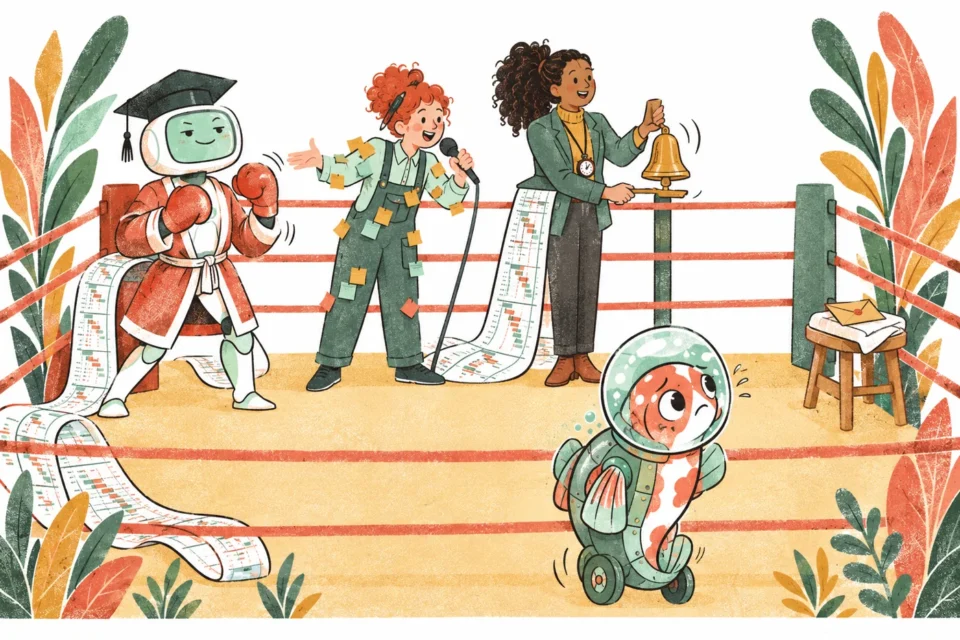
Looking at our empty slot for Gap 4, we had an idea. What if we turned Gary's answers into a live experiment? What if we fed the same questions into ChatGPT and Gemini, created a synthetic persona called "GaryGPT," and ran a side-by-side comparison to see how the machines held up?
Our intentions were genuine. As a patient expert myself, living with inflammatory bowel disease since 2007 and accumulating numerous other conditions, I am fiercely protective of lived experience. I wanted to produce a piece that proved why healthcare and pharmaceutical companies cannot replace real patient advisory boards with synthetic AI personas.
We drafted the piece, framed it playfully like a boxing match ("Gary vs GaryGPT"), and sent it over to Gary to review.
In my eagerness to champion real patients and prove a conceptual point, I made a critical, inadvertent mistake: I never discussed the idea with Gary before running his life through the models.
Before sharing what happened next, it’s worth looking at the answers Gary gave, because they show the immense gulf between lived reality and statistical prediction.
Gary has lived with severe haemophilia since he was a baby, growing up with 0% natural clotting factor. When I asked him about how he navigates treatment decisions, why he prefers quiet 1-to-1 conversations over public support groups, and what his passions are outside of his condition, he did not give polished marketing copy. He gave us the texture of his life.
He told us about the isolation of growing up as the only person with haemophilia in the entire county of Suffolk, and how to this day he has only ever met three other people with his condition.
He shared the origin of his independent mindset: how, as an infant, he was admitted to hospital covered in unexplained bruises. Suspecting abuse, doctors separated baby Gary from his parents for two days. A nurse starting her shift heard him crying, remembered a medical journal entry she had just read, and asked: "Could it be haemophilia?"
When his parents were reunited with him, that same nurse gave them a piece of advice that defined Gary's upbringing: "Do not wrap him up in cotton wool; let him find his limits and how to handle them."
He told us about the financial panic of a family holiday where an unexpected injury required extra clotting factor abroad. Getting that medication would have cost thousands of pounds that his family simply did not have.
He explained his personal risk assessment for a simple walk in the countryside:
Gary also explained how clinical trials changed everything for him. Seven years into a gene therapy trial, his liver now produces 82% clotting factor. That shift meant he could finally travel freely for his career in shoe manufacturing, visiting factories in Vietnam and China for months at a time, something that would have been unthinkable when a single bleed could be catastrophic.
When we asked ChatGPT and Gemini the same questions, the models produced well-written, articulate responses. They used all the right words: uncertainty, stability, monitoring, and listening. They were polite, safe, and completely generic.
Worse, where the models lacked information, they hallucinated plausible clichés. When asked about his personal passions, both models independently decided that "Gary" was an avid landscape photographer who spent weekends waiting for the sunrise in the Peak District. Gemini even generated an emotional backstory about how new therapies gave him the mobility to hike in the cold, trading worries about factor levels for f-stops and shutter speeds.

It was touching, fluent, and entirely fabricated.
On paper, the synthetic answers looked neat. But they offered an average of everything ever published about chronic illness, not the reality of living it.
Gary replied to my email:
"I'm going to be 100% honest here, I do not like the idea of AI getting involved with 'human, life altering decisions', this does not sit well with me at all. If someone told me the information I was reading to help me make such an important decision was generated by an AI agent, I'd throw it straight in the bin.
The answers I gave are based on 44 years of living with Haemophilia, my experiences, worries, fears and expectations. I struggle to see why the team felt it necessary to pit my life against an AI entity and dress it up as 'face off' to see who gave the best answers. It's dehumanising my life."
Gary was completely and undeniably right.
In our rush to create a clever article, we had taken 44 years of a man's medical history, childhood hospital trauma, family financial anxiety, and personal resilience, and turned it into an arena sport. We had gamified the very lived experience we set out to protect.
I wrote back immediately to apologise. As someone who lives with chronic illness, I know how heavy healthcare trauma can be. It dictates how we make decisions, how we interact with clinical teams, and how we protect our energy. A computer can never experience that trauma, and it can never understand it. By failing to ask Gary's consent before using his words in an AI experiment, I had temporarily lost sight of that human boundary.
Gary accepted my apology with immense grace, writing back:
"As you said, no computer can 'experience life' as we do and will never feel as we do and our feelings are our most important link to humanity and should be protected at all costs. These feelings and passions behind them are the only tools that should be used to guide someone before any life-altering transition."
We set out to write an article explaining Gap 4: Emotion has consequences; description doesn't. We ended up learning it firsthand.
In our white paper, we cite a 2023 study in JAMA Internal Medicine showing that clinicians often rated AI chatbot responses as more empathetic than those from real physicians. AI is remarkably good at mimicking the language of empathy. It can produce soothing, polished sentences on demand. What an AI cannot do is have anything at stake.
When an AI drafts a paragraph about the fear of an infusion, it risks nothing. When it invents a story about landscape photography, it bears no cost. A model does not feel its joints aching when the winter damp sets in. It does not worry about being stranded miles from help on a countryside trail. And it certainly cannot feel the indignity of having its life compared to an algorithm.
Gary felt all of those things. His reaction had real consequences: his personal dignity, his boundaries, and his trust in our partnership.
This is the exact danger facing life sciences teams who are tempted by "digital twins" and synthetic patient panels. A synthetic patient will never tell you that your question is inappropriate. It will never challenge an unrealistic trial protocol, push back on an unworkable appointment schedule, or withdraw its consent. It will simply generate agreeable, average answers that look neat on a slide deck while real patients quietly discontinue therapy in the real world.
At merakoi, we are not anti-AI. We use AI every day to summarise lengthy transcripts, analyse research patterns, and streamline operations. Patients use it too, often to decode confusing consultant letters or prepare questions for brief specialist appointments.
The principle we stand by is simple: Humans are the source. AI is the multiplier.
AI is an extraordinary tool for scaling, structuring, and translating insights. But a multiplier with no source multiplies nothing. If you feed an algorithm synthetic prompts, you get synthetic conclusions. When you need to understand how a therapy fits into a human life, there is only one source that matters: a person who has actually been there.
We chose to share this experience publicly because genuine patient engagement demands accountability. If we expect healthcare teams to treat lived experience as a vital strategic asset rather than a checkbox exercise, we have to hold ourselves to that exact standard.
Lived experience isn't raw data waiting to be prompted. It is a life, lived with consequence.


✕